The Challenge of Data Integration
In the fashion and retail industry, sustainability efforts hinge on accurate and comprehensive data. Yet, one persistent roadblock is addressing data mapping problems in LCA and carbon accounting. Mismatched taxonomies, inconsistent file formats, and time-consuming manual mapping processes create a logistical nightmare for organizations trying to import bulk data into sustainability platforms. At Carbon Trail, we’ve seen this challenge firsthand. Customers using ERP and PLM systems with unique data structures often face a time-intensive preparation phase, slowing down their journey toward automated carbon accounting and impactful sustainability initiatives. To address this, we’ve launched our AI-Powered Bulk Import Workflow, designed to simplify data integration, eliminate bottlenecks, and accelerate your sustainability efforts.
Why This Matters
Efficient and accurate data imports are critical for businesses pursuing sustainability. Here’s how our new feature transforms the process:
1. Bridging Taxonomy Gaps
Every organization categorizes and structures data differently. Our AI engine bridges these gaps by simplifying the mapping of your internal taxonomy to Carbon Trail’s system, saving valuable time and effort.
2. Reducing Manual Effort
Manual mapping is prone to errors and takes significant resources. By automating column and value mapping—even for complex cases—our workflow ensures you focus on leveraging data for actionable insights instead of struggling with tedious uploads.
3. Scaling Sustainability Efforts
Bulk imports aren’t just about efficiency; they unlock scalability. By enabling the seamless import of hundreds or thousands of records at once, businesses can onboard data faster, empowering them to make progress toward automated carbon accounting & LCAs.
How It Works: AI-Powered Magic
Our new bulk import feature is built to handle real-world complexities with advanced capabilities:
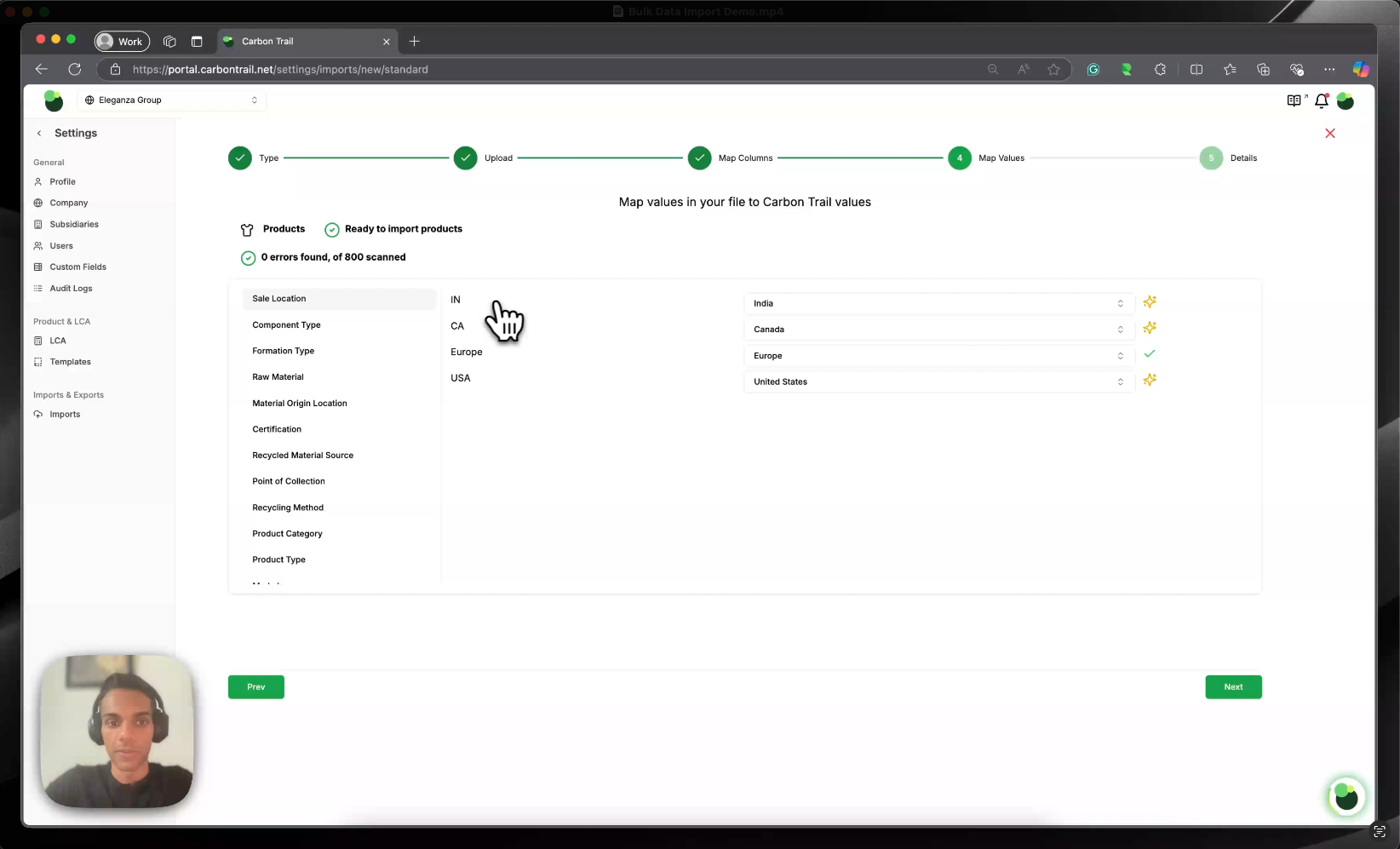
1. Automatic Column Mapping: The system identifies matches between your file’s headers and Carbon Trail’s fields, mapping the majority of columns for you.
2. AI-Driven Value Matching: From fixing typos (e.g., "polystr" → "Polyester - Fossil") to interpreting different formats (e.g., country codes vs. country names or 'Organic Cotton' vs 'Cotton - Organic'), our AI engine ensures seamless integration.
3. Custom Fields Support: Your unique data fields, like product categories or collection names/seasons, are supported and mapped automatically, ensuring flexibility.
A Step Towards Seamless Sustainability Management
The AI-Powered Bulk Import Workflow is more than a feature—it’s a step forward in tackling data mapping problems in LCA and carbon accounting. By allowing businesses to efficiently import complex data like product details and materials, this tool reduces barriers to sustainability progress. And this is just the beginning. Upcoming enhancements include support for bulk imports of suppliers, facilities, and other key entities, ensuring the workflow evolves with your needs.
What's next?
At Carbon Trail, we’re committed to building tools that empower you to make sustainability management smarter, faster, and more accessible. With the AI-Powered Bulk Import Workflow, we’re helping organizations of all sizes move past data integration hurdles and focus on driving measurable impact. Check out the video at the beginning of this post to see the feature in action, or schedule a demo to learn how this tool can support your sustainability goals.