In effect
Company
Adopted
The UK FCA Listing Rules regarding the Task Force on Climate-related Financial Disclosures (TCFD) aim to enhance transparency in how businesses address climate-related risks and opportunities. This regulatory framework requires fashion companies to disclose their governance, strategy, risk management, and metrics related to climate change impacts. As the fashion industry grapples with the pressing need for sustainable practices, these rules emphasize accountability and investor protection.
Some of the mandatory reporting obligations under UK company law correlate with TCFD guidelines so that companies conduct their operations responsibly about climate risks.
These legal obligations together with those set by the FCA form a consistent set of requirements to address climate disclosure aligned with the TCFD.
Fashion brands must comply with specific sustainability reporting obligations under the FCA UK Listing Rules. These include:
The FCA UK Listing Rules primarily affect publicly listed fashion companies, including those on the London Stock Exchange. Any fashion retailer with a premium listing must adhere to these rules and report on TCFD recommendations, aiming for enhanced transparency and sustainability practices.
Initial disclosures for premium listed companies began.
Further guidance was issued, and larger companies must provide detailed TCFD reports.
Ongoing reporting requirements; companies are expected to refine and enhance their disclosures annually.
The UK FCA Listing Rules set out the requirements for climate-related disclosures for companies listed on the London Stock Exchange, primarily focusing on TCFD recommendations.
Publicly listed fashion companies on the London Stock Exchange with a premium listing are required to comply with the TCFD reporting requirements.
Companies must disclose information about governance, strategy, risk management, and metrics related to climate change impacts.
The requirements began in 2021, with further guidance issued in subsequent years, and ongoing annual reporting obligations for companies.
Carbon Trail offers services such as data collection, reporting assistance, and sustainability solutions tailored to help businesses comply with regulatory requirements.
Non-compliance can lead to reputational damage, financial penalties, and a loss of investor confidence.
Elevate your product with our comprehensive suite of solutions
If the new French Textile Environmental Cost law (a.k.a. the France Textile Eco-Score) is to be seen, then yes, anyone can publish the official Environmental Cost scores for your textiles if you don't yourself disclose them by the end of the voluntary phase.
The new Textile Environmental Cost, (coût environnemental) enters into force in as of today - the start of October 2025. The portal to report the different metrics for textile manufacturers has been open since mid-September. The enforcement initially begins with a voluntary phase from 1st October 2025. Anyone can publish a score on your behalf if you have not published a score by the end of the voluntary phase. No permission needed, and this will be an official score displayed on all your garment tags, website, and product pages.
The new decree requires all companies who sell garments in the French market, not just French companies, to publish an "Environmental Cost" score for each of their products. This is an aggregate score that considers all factors related to the environmental impact of a garment. This includes carbon emissions, energy use, microplastic impact, durability, and more. All companies are encouraged to publish a score in the voluntary phase beginning in October 2025. Once the voluntary phase ends, ANYONE can publish a score on behalf of the companies if they continue to sell in the French market. A detailed analysis of the Environmental Cost decree can be found here.
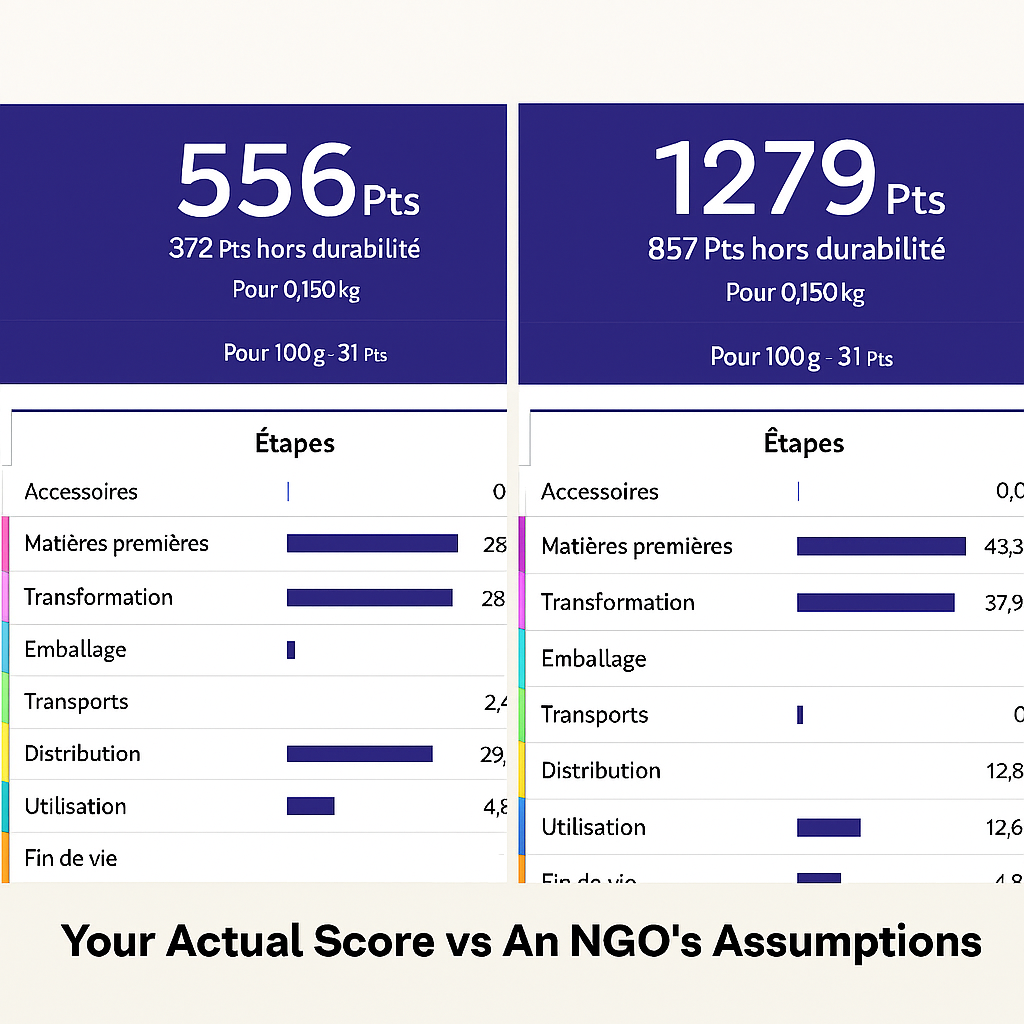
What does this mean? NGOs who might use assumptions for your supply chain will control your narrative. They might publish a score which might denote a far higher environmental impact than actually the case. From an NGOs perspective trying to champion the cause of the environment, they will use negative estimates where subjectivity is permitted. For example, standard (or even unsustainably sourced) cotton, zero recycled fabrics, high transport emissions, and poor durability. While you may think your brand's organic cotton tee shirt may land a low environmental cost score of 500 (lower score is better), the NGOs assumption may lead to a score calculation of 1000+. Our team analysis has observed this in the official Environmental Cost portal.
It is also worthwhile to note that the Environmental Cost score will be visible everywhere. In physical stores on product tags, online in the product description, and with QR codes that redirect consumers to a landing page with the breakdown of the score. It is the first instance where factors like durability are also included. These have until now have not had much negative impact on fast fashion companies. If you're a textile brand selling apparel in the French market and you haven't submitted data to calculate your score, any third-party can publish a score for you once the voluntary phase ends. This will be mandated to be included on your own product pages, tags, and more.
Suppose your company manufactures a tee shirt. It uses 150g cotton, with 80% organic cotton and 20% sourced from production waste. You've set up your supply chain in an Eastern European country from the spinning to weaving to stitching. You use custom steps in the process to reduce the environmental impact and minimise your fabric wastage in production. By entering data in the Environmental Cost portal, you have achieved a low score of 500+ for your tee shirt.
The same score calculated by a third-party like an NGO may not be the same. How? Well for example, the NGO will assume your cotton to be standard cotton - not recycled or organic. Then, it will take a look at your product tag which says "Made in the Czech Republic". They naturally assume that it is for the final step, not the spinning of the yarn all the way to weaving the fabric. They assume that these initial steps are done in Asia-Pacific and accordingly take the average values. It will also consider industry default processes, industry averages of the manufacturing steps and assume a standard fabric wastage value. The result? Your low impact tee shirt in reality gets a high score of 1279. Good luck convincing your customers to buy your "organic" tee shirts now.
The short answer is very much worse. As seen in the example above, assumptions made by a third-party even with the best of intentions will lead to a significantly worse Textile Environmental Cost for your garments. There needs to be no malicious intent for general assumptions like standard cotton, industry average processes, and sourcing the yarns to spin your fabric from major global hubs. Yet, these can lead to a worse Textile Environmental Cost for your products, as calculated on the official portal.
So how do you control your narrative? How do you communicate your true environmental cost to your customers? Not an exaggeration by a third-party which has no stake in your business? One option is getting started with the portal yourself or through your company's legal team. However, keep in mind that the Environmental Cost requires 10+ variables per garment type you sell. Multiple that with 100s of types and styles you might sell, and the input cost of gathering this data potentially exceeds your total revenue from selling in the French market.
Enter Carbon Trail - an AI powered SaaS tool specifically for textile and garment companies, that helps you navigate regulatory compliances not just like the Textile Environmental Cost, but also of those like CSRD, ESRS, and Digital Product Passport. Undertake LCA impact assessments in days instead of months, at a fraction of the cost while traditional LCA assessments can cost you $10,000+/product.
If you make or sell apparel in France, the new “environmental cost” or France Textile Eco-Score label is about to touch everything from your bills of materials to your product
Measuring product footprints is hard work. Data is often incomplete, assumptions creep in, and getting inputs from across teams and facilities can be a challenge. At Carbon Trail, our
At Carbon Trail, we spend a lot of time talking to sustainability teams, product managers, and compliance officers. And recently, we've been hearing some recurring themes: “I’m not sure