What is a Climate Tipping Point?
The concept of climate tipping points refers to the state in the Earth’s climate system at which certain changes have occurred. When crossing this threshold, it unleashes drastic and profound changes and alters the climate system. They can lead to what is known as cumulative or flow-on effects on ecosystems and on human societies. For instance, the Greenland Ice Sheet is a famous example of a tipping point. When ice melts enough, ocean currents may be affected, and the global warming process is enhanced with a huge rise in sea levels. Climate Tipping points, on the other hand, indicate fast changes, and there will be little time to adapt to the change.
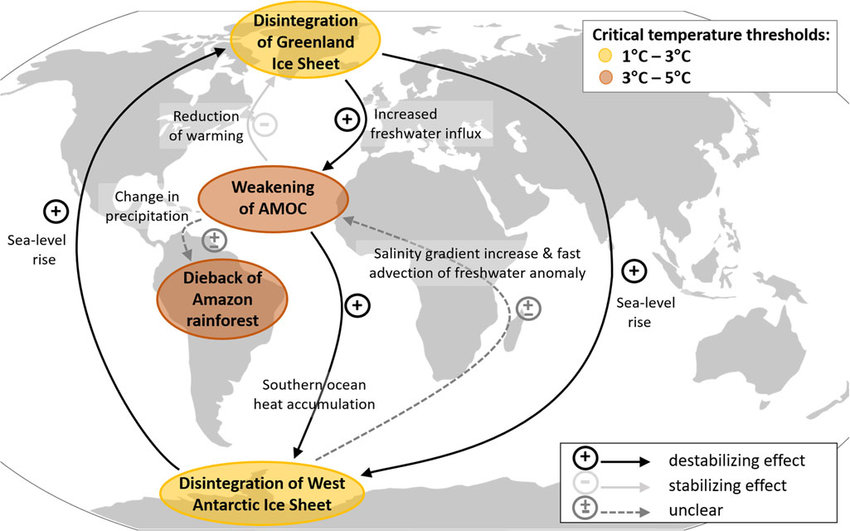
Key Climate Tipping Elements | Source: ResearchGate
Key Characteristics of Climate Tipping Points in the Climate System
- Sudden Onset of Changes: While slow and gradual changes are characteristic of a tipping factor, the outcome is a radical change. For instance, when the ice melts somewhere, say in the Arctic, it may reach a crucial level that causes an increase in ice reflectivity and, in turn, increases warming.
- Long-term Impacts: While crossing them, the tipping points have a long-term impact which is almost always impossible to revert. For example, the Amazonian rainforest region is predicted to change from a net carbon storage system to a carbon emissions source if deforestation and global warming persist.
Examples of Changes in Climate Tipping Points
- Melting of Polar Ice Caps: The sea ice in the Arctic and Antarctic region is thinning at unprecedented rates, thus contributing to the increase in sea level. Between the period of 1993 and 2019, globally the Greenland Ice Sheet has been losing around 3.8 trillion tonnes of ice.
- Collapse of Ocean Currents: The Atlantic Meridional Overturning Current which controls climate trends is slowing down as a result of ice melt. It could cause colder winter conditions in Europe and fail monsoon rains in Africa.
- Thawing of Permafrost: The carbon that is found in permafrost is one of the largest pools of carbon in the world. Its melting also emits methane, one of the most powerful global warmers, and in a cycle that fuels global warming.
Recent Research on Climate Tipping Points
Emerging Findings in Climate Science
Recent studies emphasize the pressing need to understand and mitigate tipping points in the climate system. The IPCC’s Sixth Assessment Report (2023) identified nine key tipping elements, warning that some could be crossed within decades if global temperatures rise by 1.5°C to 2°C. A 2022 study published in Science revealed that four major tipping points, like the Greenland Ice Sheet collapse and coral reef die-off, could become unavoidable within this century without significant emission reductions. The researchers emphasized that limiting global warming to 1.5°C would halve the likelihood of crossing these critical thresholds.
Vulnerable Systems Identified
- Arctic Ice Sheets: The Arctic region, for instance, is warming at about 3.8-fold the global average rate. This is making ecosystems and global water levels insecure. This rapid change impacts communities that depend on frozen terrains for the economy and development of infrastructure.
- Amazon Rainforest Dieback: The Amazon has been reduced by 17 percent as a result of deforestation. If this figure rises to 20-25%, it can trigger a feedback loop. It may further turn itself into a savanna-like landscape and release loads of carbon into the atmosphere.
- Coral Reef Degradation: The increase in the ocean’s temperatures and its tendency to grow acidic will adversely affect the coral reefs that nurture a quarter of marine life. Without urgent action, 90% of the world’s coral reefs could be gone by 2050.
The Timeframes for Crossing Climate Tipping Points
- The Greenland Ice Sheet really may cross a dangerous tipping point before the year 2030 if warming stays on its present course.
- The Atlantic Meridional Overturning Circulation (AMOC) could fall apart between 2025 and 2095 according to most recent probabilistic models.
- The existing coral reefs could degrade almost to some extent if the international temperatures exceed 1.5°C in the next three decades.
It is now time for action, especially to avoid the negative impacts of climate change on sustainable development. For scientists, such a delay would intensify the risks, thus making it impossible to restore the affected systems.
Major Climate Tipping Points in the Climate System
Arctic Ice and Ocean Circulation
The melting of Arctic ice significantly influences global weather patterns and accelerates sea level rise. Arctic sea ice acts as Earth’s reflective shield, bouncing sunlight back into space. As ice melts, darker ocean surfaces absorb more heat, creating a feedback loop that intensifies warming. This process disrupts the Atlantic Meridional Overturning Circulation (AMOC), a vital ocean current system that stabilizes weather patterns. Weakening AMOC can lead to extreme winters in Europe, intensified hurricanes in North America, and disrupted monsoons in Africa. According to NASA, Arctic sea ice has declined by 13% per decade since 1979, signaling the urgency to mitigate warming in this region.
Greenland and Antarctic Ice Sheets
The Greenland and Antarctic ice sheets contain enough trapped water to cause a global sea level rise of more than 60 meters in the event of melting. Currently, both are melting at high rates due to global warming. The Greenland Ice Sheet is especially fragile. According to studies, it has melted with nearly 3.8 trillion tons of ice between 1993 and 2019, accounting for 0.88% of the global sea-level increase. The same problem confronts Antarctica. The retreat of the Thwaites Glacier, also known as the ‘Doomsday Glacier’ threatens to cause disastrous floods in coastal cities such as New York and Mumbai. Some of the limits may be crossed in several decades, but still, there may be more influences due to which it becomes critical to come up with urgent measures.
Tropical Rainforests and Ecosystem Balance
The Amazon, which is known as the Lungs of the Earth, is also significant as a carbon offset, where it helps to capture about 2 billion tons of CO₂ a year. However, deforestation and rising temperatures are forcing it to move towards a critical threshold, beyond which it could potentially turn into a savanna. This change could happen if 20% to 25% of the Amazon is deforested, the current level being close to 17%. Besides, carbon storage, rainforests should be preserved to support biological diversity, since the Amazon alone has 10% of all known species.
Coral Reefs and Marine Biodiversity
Endangered marine resources such as coral reefs are at peril due to ocean acidity and increasing temperatures. These reefs feed a quarter of marine species and directly and indirectly feed millions of people with food. However, lengthy heat waves can trigger coral bleaching, during which corals expel colorful, nutrient-providing algae. The Great Barrier Reef has now suffered four bleaching events since the start of 2016. The IPCC also estimated that if no more improvement is to be made, up to 90% of the world’s coral reefs may be destroyed by the year 2050. This would further worsen the condition of seas, oceans, marine species, and the human societies relying on these ecosystems.
Why Addressing Climate Tipping Points is Crucial
Economic and Societal Implications
Unchecked tipping points will have dire consequences for economies and livelihoods. The collapse of ice sheets and ocean currents will lead to more frequent and severe natural disasters, causing billions in damage annually. For instance, the 2021 floods in Europe, linked to changing climate patterns, resulted in $43 billion in economic losses. Tropical rainforest loss will impact agriculture by altering rainfall patterns, while coral reef degradation threatens fisheries that provide food for over a billion people globally. These cascading effects will disproportionately affect vulnerable populations, exacerbating inequality and displacement.
Environmental Impacts
Climate tipping points bring irreversible damage to ecosystems, leading to biodiversity loss on an unprecedented scale. The Amazon’s transformation into a carbon source would accelerate global warming, while Arctic melting could release methane trapped in permafrost, intensifying the greenhouse effect. Coral reef collapse would devastate marine species and erode natural storm barriers, increasing the vulnerability of coastal regions to hurricanes and tsunamis. Addressing these tipping points is essential to preserve the balance of Earth’s interconnected ecosystems and to secure a livable planet for future generations.
How to Prevent Climate Change Tipping Points
Strategies for Mitigation
Cutting the emissions will help prevent the world from crossing climate thresholds. This includes shifting from fossil energy to renewable energy such as solar, wind, and hydropower, which IRENA estimates could deliver 90% of the required emission cuts. Technologies such as carbon capture and next-generation nuclear energy support this transition by directly dealing with risks such as arctic ice meltdown and rainforest dieback by stabilizing the world temperatures. Maintaining a carbon storage system like forests and wetlands is just as important. Schemes such as the Trillion Tree Campaign plant trees and store carbon, while the preservation of ecosystems such as the Amazon does not allow them to fail. One practical and cheap option to lower pollution is methane, with agriculture and waste being significant contributors to climate change.
International Cooperation and Policies
The Paris Agreement aims to limit global temperature increases to 1.5–2°C. 195 countries, including the EU, commit to emissions reductions through NDCs. Ad hoc groups such as the High Ambition Coalition bring together countries to raise ambition on climate action. Carbon credits, for instance, and the EU’s Emissions Trading System compel industries to reduce their emission rates responsibly. The Green Climate Fund finances renewable energy and climate adaptation in developing nations.
Public Awareness and Action
It is therefore important to inform the public and encourage them to take the necessary action towards climate tipping points. Fridays for Future demands stricter climate policies from policymakers. People can also help by using energy sustainably, using fewer resources, and changing their diets. As the analysis by Project Drawdown indicates, it could decrease agri-food emissions by a significant margin. Roof gardens and energy-efficient structures effectively address climate challenges in urban communities. Awareness activities encourage sustainable behaviors and strengthen resilience to climate change.
Conclusion
Climate tipping points are critical to understanding and addressing climate change impacts on societies and ecosystems. Exceeding thresholds could trigger chain reactions harming ecosystems, economies, and societies globally. Near-term actions include cutting emissions, practicing sustainability, and fostering global collaboration for climate resilience. Carbon Trail supports this mission by offering tools that enable organizations to assess their carbon emissions effectively. It helps prevent climate tipping points by identifying key areas for emission reduction focus. At Carbon Trail, companies find a way to manage the consequences of climate change through effective tools and data-driven approaches.